
Maybe You Don't Need a Better Plan


"I just need a good plan."
How many times have you said some version of that?
A better morning routine.
A more realistic to-do list.
Three priorities instead of ten.
A new calendar system.
A better way to organize the day.
Sometimes we really do need a better plan - and sometimes the plan isn't the problem.
I was reminded of this recently while coaching someone I've worked with off and on for a while.
She came into our session frustrated by all the things she wasn't getting done. There was homework from different programs, things around the house, recordings she wanted to watch, projects she wanted to complete.
There was a lot.
And as she talked, I noticed something happening...
Her speech got faster. Her breathing moved higher into her chest. Her shoulders became tense and started creeping toward her ears. Her eyes darted around.
And the stories started coming.
Stories about why she does what she does. Explanations for why things are hard. Old beliefs and patterns I'd heard before.
She was getting further and further into her thoughts and further away from her body.
I knew this place. We'd been here before. And we'd tried the plans.
So this time, instead of helping her create another one, I asked if we could pause.
The pause is powerful.
We took a few slow breaths. I invited her to feel herself sitting on the couch.
Nothing dramatic. Just a moment to come back to her body.
And then she said:
“I feel like the five-year-old is driving the bus.”

There it was.
The opening.
I didn't know where the conversation was going. That's important. I wasn't thinking, Aha! I know what this means. I didn't know what it meant.
But metaphors often give us an opening into something that hasn't found direct language yet.
So instead of returning to the plan, we got curious about the bus.
Who else was on it? What did the five-year-old need? What was she trying to do?
We honored that younger part of her instead of trying to kick her out of the driver's seat.
There were tears. Her body began to soften. Her eyes softened. Her breathing changed.
And then, as often happens when we stop trying to force an answer, something else emerged.
She began talking about two very different parts of herself.
One wanted to relax, enjoy life, and take things more slowly.
The other was a mega-achiever. She wanted to accomplish things. Perform. Be successful. Keep moving.
Neither part was wrong. Neither part needed to disappear. But they were pulling in different directions.
No wonder she felt stuck.
What if stuck isn't actually stuck?
When someone tells me they're stuck, usually they know what they want. They have a goal. They have a vision. They know what they want to change, accomplish, or experience.
But something unseen is keeping them from moving toward it.
A common instinctual reaction for the listener is to fix the problem. Make the plan. Find the strategy. Get more disciplined. Push through the resistance.
But I've come to see stuckness differently.
Sometimes what we call stuck is simply a part of us that needs attention before we can move forward.
Something wants to be heard.

Fear.
An old belief.
A protective pattern.
Grief.
A younger version of ourselves.
Two needs that appear to be in conflict.
We can keep trying to overpower those parts of ourselves. Or we can become curious about them.
That's where the work went in this session.
I guided my client through an exercise that allowed these two seemingly opposing parts to communicate.
What do you want the other part to know?
What do you need from her?
What do you want to contribute?
Eventually we discovered something neither of us knew when the session began.
Both parts wanted the same thing.
They wanted her to be safe.
They were simply going about it in very different ways.
That changed the conversation.
Fear isn't always the enemy.
We spend a lot of time trying to get rid of the parts of ourselves we don't like: fear, procrastination, perfectionism, resistance, the inner critic, the part that wants to hide.
But what if, before trying to eliminate one of those parts, we asked:
What are you trying to do for me?
Fear, in particular, has good intentions. It wants to protect us from embarrassment, rejection, failure, shame, making the wrong choice, looking foolish.
Fear wants safety.
The problem is that fear also wants us to believe it can predict the future.

It can't.
Sometimes the strategies that once kept us safe eventually become the very things keeping us from growing.
That doesn't make them bad. It makes them worth understanding.
Because when we stop fighting ourselves, something can soften.
And curiosity is allowed in when we soften.
The plan wasn't the real work.
By the end of our session, my client was different from the person who had started it.
Not because we'd solved her life. We hadn't.
She still had things to do. She still had responsibilities. She would still need to make choices about how to spend her time.
But her body had changed.
She was relaxed. Her eyes were softer. Her breathing had slowed. She felt connected to herself again.
At one point she realized she'd even forgotten what she'd been so afraid of when we started.
The circumstances hadn't magically disappeared.
Her relationship with them had changed.
And that created something another productivity plan couldn't give her:
Choice.
She wasn't simply being driven by the loudest thought or strongest protective pattern anymore.
She was back in the driver's seat.
Maybe we need to listen differently.
This session reminded me of something I believe more deeply all the time:
We don't always need more information.
And we don't always need someone to give us the answer.
Sometimes we need someone who can listen without trying to fix us.
Someone who isn't looking for the broken parts or the answer, but listening for the opening to a deeper truth.
That kind of listening can be difficult to do on our own.
We are inside our own stories. We've heard them so many times that they can sound like facts.
Another person can sometimes notice the repetition. The change in our breathing. The metaphor we almost skipped past. The contradiction. The sentence that suddenly carries more energy than everything that came before it.
Instead of telling us what it means, they can pause and ask:
What do you notice?
That is one of the things I love most about coaching.
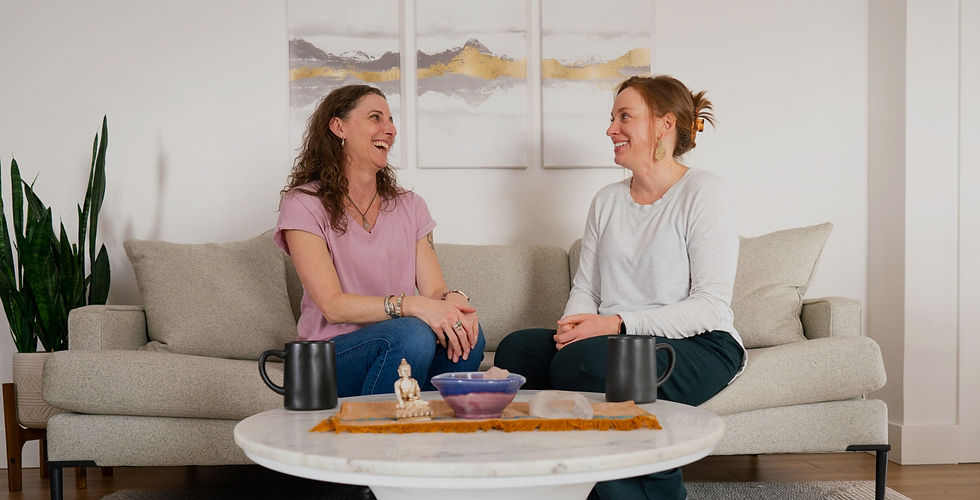
I'm not there to be the authority on someone else's life.
I'm there to listen deeply, ask questions out of genuine curiosity, and create enough space for the person sitting across from me to hear themselves.
Because the deeper truth usually doesn't arrive shouting.
Sometimes it begins with something as simple as:
It feels like the five-year-old is driving the bus.
And that's enough.
We don't have to know where the road leads yet.
We just have to be willing to listen.
Something to try
If you've been circling the same problem, making the same plan, or promising yourself once again that this time you'll finally get it together, don't make another plan just yet.
Pause.
Come back to your body.
Notice your breath. Your shoulders. Your belly. Your jaw.
Then ask yourself:
What if I'm not actually stuck?
What might need my attention right now?
What am I trying to protect myself from?
And then don't rush to answer.
Listen.
You might be surprised by what has been waiting for enough quiet to finally be heard.


Comments